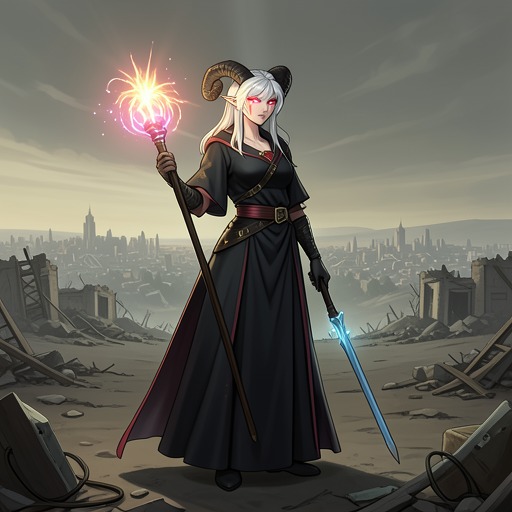
Vivi's Transmigration
New Life as a Max Level ArchmageVivi's Transmigration is the decisive threshold event of the story: Vivi awakens not in an imagined simulation but in the Burial Room of the Ashen Hierophant, physically inhabiting her own character, Vivisari Vexaria. The transfer turns a game she knew through repeated play into a dangerous reality whose history has continued without her, making her both an outsider and a figure already sanctified by legend.
Awakening in the Burial Room
Vivi opens her eyes against the armrest of a massive obsidian throne in the Burial Room of the Ashen Hierophant. The yawning spires around the arena, the nearby bubbling lava, and the heat against her face are immediately recognizable because she had run the final boss fight of Seven Cataclysms at least a thousand times. Recognition therefore arrives before comprehension: the place belongs to a familiar game encounter, but the heat and physical sensation are too vivid to remain safely fictional.
Her first response is bewilderment. She wonders whether she has gone crazy, yet the voice that answers her suspicion already sounds wrong. When she examines herself, the discrepancy becomes undeniable. Her pale white hands have creases in unfamiliar places, and she can feel the texture of her cheeks with unnerving realism. The examination is not abstract reasoning but a bodily test: sight, touch, and the movement of a clenched fist establish that she is present in flesh rather than dreaming.
A Body and Mind That Are Not Entirely Hers
The transmigration does more than relocate Vivi. It places her in the body of Vivisari Vexaria, the character she created at fifteen and retained because she had grown attached to the dramatic name and the younger self it represented. The character is not merely an avatar she can operate from outside; it is now the body through which she must perceive, move, and survive. Her old identity remains continuous enough for her to recognize herself, but that continuity is unsettled by the fact that her appearance and physical capacities belong to another constructed identity.
Magic provides the clearest proof that the transfer has altered her mental as well as bodily condition. Vivi has always favored mage classes and admired the spell design of Seven Cataclysms, where casting had been reduced to commands or gestures. In the new world, however, mana is an actual resource within her body: she reaches inward to a glowing energy core high in her stomach, channels mana through numerous internal pathways, and shapes it into ordered, molten patterns by instinct. The process feels as natural as breathing even though she has never cast a spell before.
This effortless competence creates the central ambiguity of the event. Vivi concludes that she has not simply received a new body; additional material appropriate to Vivisari Vexaria has been placed in her mind. She remains certain that she is the same person and that nothing essential has been replaced, but she now possesses knowledge and reflexes that cannot have come from her former life. The transmigration thus preserves personal identity while making identity porous, combining memory and self-awareness from Vivi with the embodied magical aptitude of her character.
From Private Rupture to Public History
The new world quickly proves larger than the scene in which Vivi awakens. She eventually encounters Prismarche's Temple, a monumental structure of polished white stone, stained-glass windows, wooden pews, and a grand altar. The temple's imagery is initially unfamiliar, but one prominent depiction shows Vivi and her Party of Heroes. Her private shock is therefore reflected in a public setting: the character she once designed for play has become a historical and religious figure in a society that venerates the group's deeds.
A priest explains that the Party of Heroes defeated the seventh and final Cataclysm roughly a century earlier, at great cost, with every member except the Sorceress perishing in the battle. The information resolves the first signs of temporal displacement. Vivi is not entering the game at the point she remembers; she has arrived approximately one hundred years after the victory that defined its remembered history. The changed city and technological advances are consequences of that elapsed century, while the missing heroes and the survival of the Sorceress create a gap between the game's familiar narrative and the world's living memory.
That history is celebrated during the Peace Day Festival, held on the centenary of the world's freedom from the Cataclysms. As citizens fill Prismarche's streets at sunset, the festival reveals how thoroughly catastrophe has been converted into collective memory and ritual. The newer generation has not personally witnessed the Rampant Genesis of the Flesh-Weaver, the Crimson Blight brought by the Reaper of the Lost Harvest, or the Great Conflagrations summoned by the Ashen Hierophant, yet the population still reveres the heroes who ended those terrors. Vivi's arrival consequently places her inside a society that has already interpreted her fictional past as sacred history.
The Threat Beyond the Familiar World
The transmigration also changes the meaning of danger. In the game, the Cataclysms had been repeatable challenges whose mechanics Vivi understood through extensive play. In reality, the world remains exposed to threats that cannot be reduced to a completed campaign. Master Aeris describes the possibility that the Dragon King might descend from the Sky-Pillar Range and raze mortal lands, that an ancient horror might awaken from a millennium-old crypt, or that another Shattered Oracle could emerge through an overambitious attempt to see beyond safe limits. His conclusion is not that danger has ended, but that there is no evidence of an Eighth Cataclysm at that exact instant.
This warning places Vivi's arrival between historical closure and continuing uncertainty. The seventh Cataclysm belongs to the past, yet the conditions that produce catastrophe remain active. The phrase that there is always an Eighth Cataclysm on the horizon turns the transmigration into more than a second chance inside a completed story: it is an insertion into a world whose apparent ending was only an interval.
Consequences for Vivi's Legend
The long-term consequence of the transmigration is that Vivi becomes capable of exceeding the identity she once designed and the power system she once mastered. Her later defeat of the Greater Voidbeast is so overwhelming that observers cannot plausibly explain it as the return of the Sorceress. Even Vivisari's legend seems too small to account for someone who can tear a Cataclysm apart with casual ease; people instead interpret the display as the intervention of a god or the descent of the heavens.
That reaction completes the event's reversal of perspective. Vivi began as a player who thought she understood the world because she had repeated its battles, but the embodied world continually exceeds her prior knowledge. At the same time, the world misreads her in the opposite direction, elevating her beyond the legendary identity she recognizes as her own. The transmigration therefore produces a double estrangement: Vivi must learn to live in a reality that no longer obeys game logic, while the inhabitants must interpret a returning figure whose power has outgrown even the myth attached to her name.